Reading Strategies
1. Using the features of a Reading passage
Before you read every sentence, look at the page as a whole. IELTS passages usually give you clues through the title, subtitle, paragraph layout, visuals, captions, and footnotes. These features help you predict the topic and decide where information is likely to appear.
Use the activity below to practise naming common passage features. Drag each answer from the box to the numbered label. One answer is extra.
Practice 1.1
Label the features of a Reading passage
Features of a Reading passage
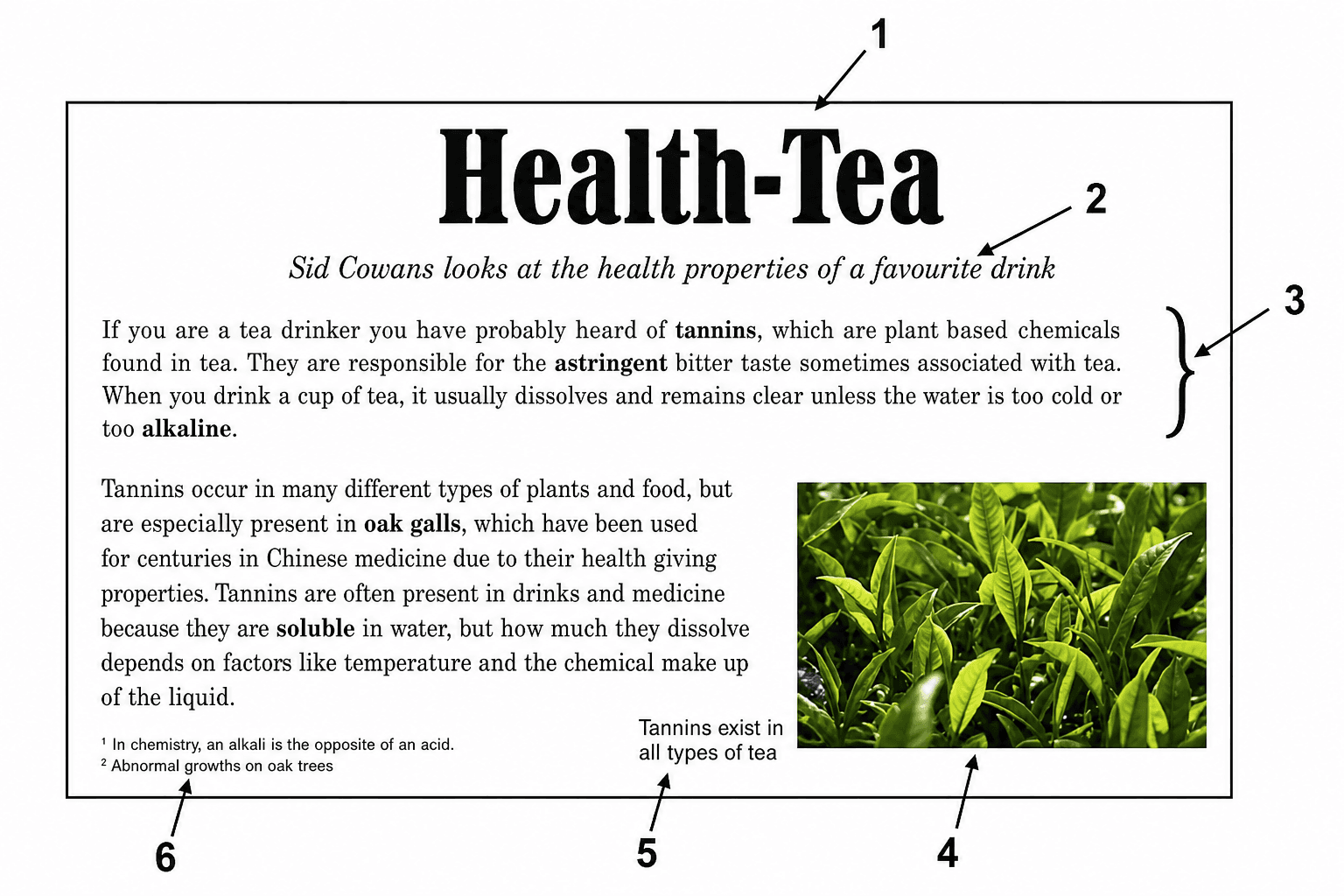
Most Reading passages will have a heading and a subheading. The subheading is used to give you the context to the passage.
Practice 1.2
Match headings A-D from four Reading passages with subheadings 1-5. There is one extra subheading that you do not need.
Researchers disagree about whether social media is making us more isolated.
Climatologists are assessing the impact of climate change on high-altitude bodies of water.
James Clegg identifies two current trends that are expanding the role of science in high schools.
Alan Parker outlines a recent breakthrough in technology.
In the 19th century, a schoolgirl and a former travelling salesman helped turn the humble soap bar into an $18 billion industry.
Understanding the context can help you to predict the type of information contained in the Reading passage.
Practice 1.3
Match the types of information 1-6 to Reading headings A-D. You will need to use the information in the subheadings to help you and you may use any letter more than once.
arguments put forward by several different experts
a description of a project in mountainous areas
a discussion about the impact of technology on society
research linked to trends in weather patterns
a historical look at a successful business venture
an argument presented from one expert's point of view
An IELTS Reading passage might contain footnotes. These help explain technical terms. Some terms are explained in the passage. Other terms can be understood by reading the text carefully.
Practice 1.4
The passage in 1.1 contains several explanations and definitions. Read the passage and match terms (1-5) with meanings A-F.
tannin
astringent
alkaline
oak gall
soluble
Practice 1.5
What helped you to identify the definition of each word?
Test Tip Timing is an important part of the Reading test. Try to finish each section in less than 20 minutes.
Read the passage as quickly as possible (up to three minutes). Look at the questions to see what type of information you need to find (up to one minute). Spend 12-13 minutes reading the passage in detail and answering the questions. If a question is taking too long, move on. Use your final 3-4 minutes to review flagged questions, fill any gaps, and check typed answers for spelling.
2. Skimming a passage and speed reading
Skimming a passage means reading it quickly (concentrating on content words, like nouns and verbs) to find the main points. It is not reading for detail. Skimming a text will also give you a general idea of how the information is organised, which can help you locate information more easily later on. In your own language, you can probably skim read 100 words in 20 seconds. In the exam, you should aim to skim read 100 words in 30 seconds.
Practice 2.1
This passage has four paragraphs of around 100 words each.
- Using a timer, skim read the text to get the general idea of what it is about.
- After 30 seconds, jump to the start of the next paragraph.
Timed skim
Read each paragraph for 30 seconds. Move to the next paragraph when the timer tells you.
Practice 2.2
Now look at questions 1-3 and, without looking at the passage, try to remember whether this information was
a comparison of children now and in the past
different hypotheses for the changes in weight
a list of factors that brought about changes in our diet
Practice 2.3
Questions 1-3 in 2.2 each give the main idea of the paragraphs in the passage. Read the questions again and decide which paragraph (A-D) they relate to.
a comparison of children now and in the past
different hypotheses for the changes in weight
a list of factors that brought about changes in our diet
3. Global understanding
Sometimes, you may be asked a question that focuses on the whole Reading passage. This type of question may ask you to choose a suitable title for the passage.
Practice 3.1
Which title (A-D) would be the most suitable for the Reading passage in 2.1?
Skim reading a passage can also give you a sense of the attitude of the writer. Global questions can sometimes focus on this.
Practice 3.2