Descriptive Passages
In this unit you will practise:
- scanning for specific details
- completing notes or a flow-chart
- recognising paraphrase
- labelling a diagram
1. Scanning for details
The passages in the IELTS Reading test gradually become more difficult, with Section 1 being the easiest.
Practice 1.1
Spend one minute skim reading the following passage to get a sense of the overall meaning. What is the main topic?
Ochre find reveals ancient knowledge of chemistry
The oldest ochre-processing toolkits and workshop ever found have been unearthed, indicating that as far back as 100,000 years ago, humans had an understanding of chemistry.
South Africa's Blombos Cave lies within a limestone cliff on the southern Cape coast, 300 km east of Cape Town. It's known for its 75,000-year-old rich deposits of artefacts such as beads, bone tools and ochre engravings. Some engravings date as far back as 100,000 years.
Archaeologist Christopher S. Henshilwood from the University of Witwatersrand in Johannesburg and University of Bergen, Norway has been excavating at the site since 1992, and has reported the discovery of a mixture, rich in ochre, stored in two abalone shells. It dates back to the Middle Stone Age - 100,000 years ago. Ochre is a term used to describe a piece of earth or rock containing red or yellow oxides or hydroxides of iron. It can be used to make pigments, or paints, ranging from golden-yellow and light yellow-brown to a rich red. Its use spans the history of humans - from those living more than 200,000 years ago, to modern indigenous communities.
Made from an array of materials, this mixture, which could have functioned as wall, object and skin decoration or skin protection (acting in a similar way to modern-day sunscreen), indicates the early developments that occurred in the people who originally used the site.
"[Judging from] the complexity of the material that has been collected from different parts of the landscape and brought to the site, they [the people] must have had an elementary knowledge of chemistry to be able to combine these materials to produce this form. It's not a straightforward process," said Henshilwood.
Practice 1.2
Scanning involves searching a text quickly for a specific piece of information. Practise scanning the passage for the words/numbers in the box.
The age of Blombos Cave's rich deposits
Cue: rich deposits of objects found at the site
The age of some engravings and of the mixture in shells
Cue: two places where the same age is repeated
How far back the use of ochre spans in human history
Cue: the oldest time reference in the passage
The general word for beads, bone tools, and ochre engravings
Cue: a category word near the beginning
The earth or rock material used to make pigments or paints
Cue: a key repeated material in the discovery
2. Using words from the passage
There are several types of question that ask you to write a word and/or number from the passage.
- You will be told the maximum number of words to write.
- You must only write words that are in the passage. Make sure you copy the spelling correctly.
- You do not need to change the words in the passage and you do not need to join words together.
- If you write too many words or make a spelling mistake, your answer will be marked wrong.
Test Tip If the question asks you to write TWO WORDS AND/OR A NUMBER, this means the answer may be:
- one word
- one word + a number
- two words
- two words + a number
Remember that even if a number is written as a word, it counts as a number (e.g. twenty five trees = one word and a number). You do not need to write full sentences or join words together.
Answer the question with NO MORE THAN TWO WORDS from the reading passage. What TWO colours did the painter use?
Answer: black, white, not black and white
2.1 Short answer questions and sentence completion tasks
Short answer questions test your ability to find specific details in a passage. Use the words in the questions to:
- help locate the relevant part of the passage
- find out exactly what details you are looking for.
Practice 2.1
In questions 1-3 below, the key words that you need to locate in the passage are in bold, and the details you need to find out are underlined. Use these words to help you locate the relevant parts of the text and then answer the questions.
Choose NO MORE THAN TWO WORDS AND/OR A NUMBER from the passage for each answer.
Practice 2.2
Look at the remaining questions, 4-6. Underline the words that will help you locate the information in the passage and highlight the details you need to find. Then answer the questions.
3. Notes/flow-chart/diagram completion
The questions in 3.1 all focus on paraphrase. Paraphrase is the use of different words with the same meaning. This helps to test how much of the Reading passage you understand.
Practice 3.1
Look again at Questions 4-6.
Sentence completion questions also test your ability to find specific details or information in the passage. You must fill in the gaps in the sentences with appropriate words from the passage. The sentences will paraphrase the words and ideas. They also contain details that help you find the part you need to read in detail.
Practice 3.2
Spend 30 seconds skim reading the next part of the Reading passage to get the general meaning.
The Blombos Cave discovery is the earliest-known example of a pigment- or paint-producing workshop. All of the materials were discovered at the same site, and they included an array of raw materials including samples of bone and charcoal, as well as pigment-producing equipment such as grindstones and hammerstones. Judging by the equipment, which shows signs of wear, Henshilwood and his team were able to deduce the process used to produce the ochre mixture.
First, the pieces of ochre were rubbed on quartzite slabs and crushed to produce a red powder. This was combined with ground-up mammal bone, the traces of which show signs that it was heated before being ground. The ochre powder and the bone pieces were mixed with charcoal, stone chips, quartz grains and a liquid (perhaps water) and was then transferred to abalone shells to be gently stirred before being ready for application.
Practice 3.3
Look at the sentence completion task below. Find words in the passage in 3.2 that are paraphrases of the underlined words.
Choose NO MORE THAN THREE WORDS from the passage for each answer.
Practice 3.4 Carefully read the text, before and after the words you have found. Then complete Questions 1-3.
Test Tip Make sure you read the whole passage so that you can locate any key words and paraphrases from the questions. In the computer-delivered test, practise using the on-screen highlight and notes tools only when they help you find evidence faster. Too much highlighting can slow you down when checking answers.
3.1 Flow-chart and Note completion tasks
A flow chart is a diagram that shows the sequence of events in a process. In flow-chart completion questions, the information may not be presented in the same order as in the passage.
Practice 3.5
Study the flow-chart completion task below. For Questions 1-6, decide what type of information you need to find.
Choose ONE WORD ONLY from the passage for each answer.
How pigment was made in ancient times
Practice 3.6 Look at the two Reading passages in 1.1 and 3.2. Which words or ideas are paraphrases of the underlined words in the flow chart? Highlight the parts you need to read in detail.
Practice 3.7 Carefully read the passages in 1.1 and 3.2 and complete the flow chart. Make sure you use ONE WORD ONLY from the passages.
Test Tip If you are asked to choose ONE WORD ONLY from the passage, make sure you do not add extra information such as adjectives or adverbs, or articles. If you write more than one word, your answer will be marked as wrong.
Note completion tasks are similar to flow-chart completion, but may cover a larger part of the Reading passage. Again, the information may not be presented in the same order as the information in the passage. Use the headings in the notes to help you find the information in the passage.
Practice 3.8
Study the note completion task below. For Questions 1-7, decide what type of information you need to find.
Complete the notes below. Choose NO MORE THAN ONE WORD AND/OR A NUMBER from the passage.
Practice 3.9 Read the passages in 1.1 and 3.2 and complete the notes. Use the same techniques you have learned from previous exercises.
3.2 Diagram completion tasks
In labelling a diagram tasks, you will see a diagram and a description of a process. You need to carefully read the part of the passage that describes the process and complete the diagram with words from the passage.
Practice 3.10
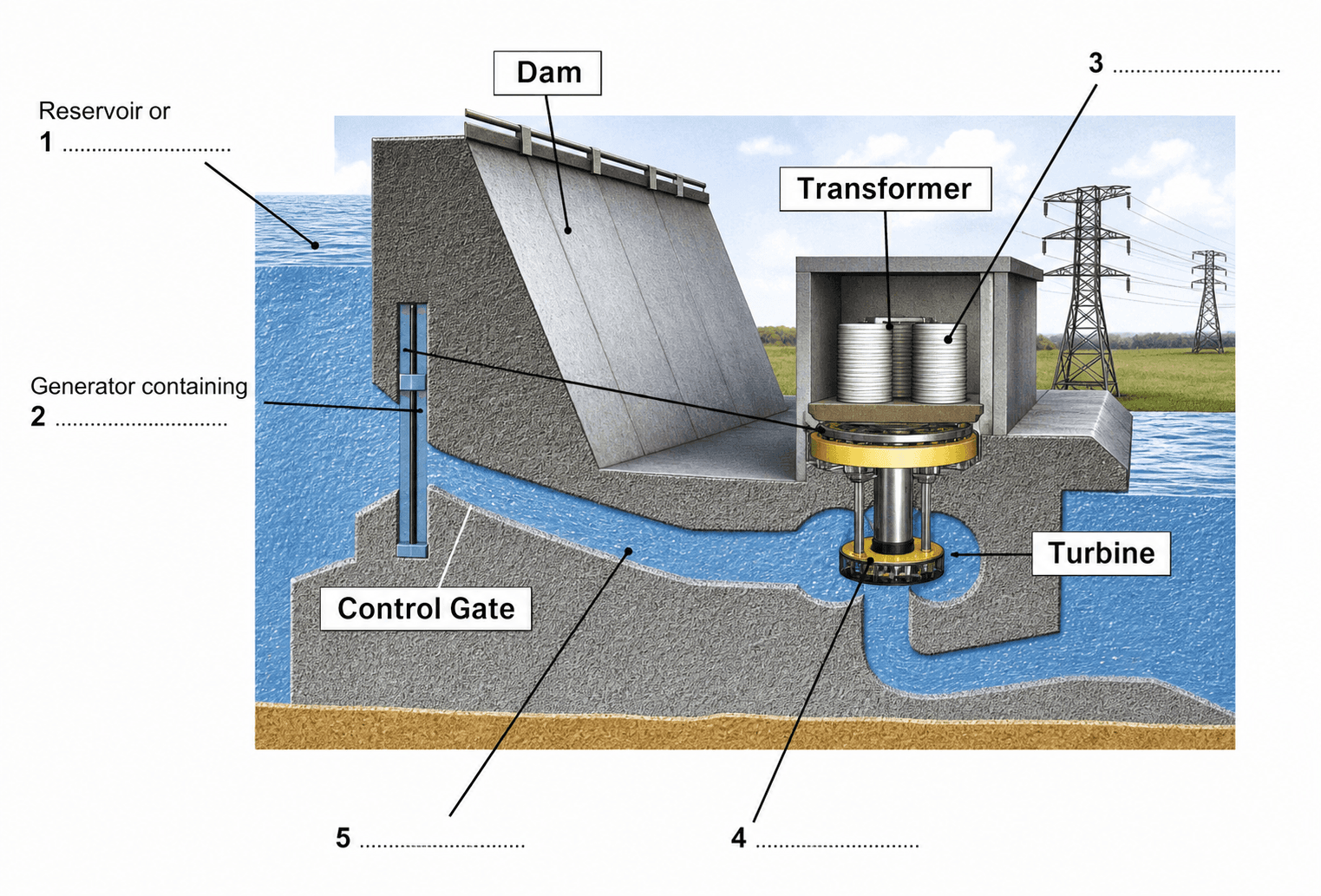
Look at the diagram. Try to imagine how the hydropower plant would work. Pay attention to how the parts are connected.
Write NO MORE THAN ONE WORD from the text for each answer.
Practice 3.11
Read the passage and underline the words that are already marked on the diagram.
The power of water
Most hydropower plants rely on a dam that holds back water, creating a large reservoir behind it. Often, this reservoir is used as a recreational lake and is also known as the intake. Gates on the dam open and gravity pulls the water through the penstock, a line of pipe that leads to the turbine. Water builds up pressure as it flows through this pipe. The water strikes and turns the large blades of a turbine, which is attached to a generator above it by way of a shaft. As the turbine blades turn, so do a series of magnets inside the generator producing alternating current (AC) by moving electrons. The transformer, located inside the powerhouse, takes the AC and converts it to higher-voltage current.
Practice 3.12 Answer Questions 1-5 on the diagram.
Practice 3.13
Replace the underlined words below with appropriate paraphrases from the text.
Type the word or words from the passage that match the underlined meaning.