Discursive Passages
In this unit you will practise:
- reading discursive passages
- identifying theories and opinions
- matching features
1. Discursive passages
The texts in the Reading test gradually become more difficult. They may present contrasting points in an argument or explain a complex theory. All Reading passages contain cohesive devices to help explain how the ideas are connected together.
Practice 1.1
Write the cohesive devices into the correct column to show why a writer would use them.
to add more / clarify a point
to show contrast / present the opposite view
to give an example
to draw a conclusion / introduce a result
Practice 1.2
Aesop's fable 'The crow and the pitcher' more fact than fiction
New research indicates that rooks are able to solve complex problems using tools.
In Aesop's fictional fable 'The crow and the pitcher', a thirsty crow uses stones to raise the level of water in a jug to quench its thirst. A recent study demonstrates that rooks, birds belonging to the corvid family, are in fact able to solve complex problems using tools and can easily master the same technique used in the story.
Christopher Bird of the University of Cambridge, who led the study, highlighted the importance of the findings, stating: 'Corvids are remarkably intelligent, and in many ways rival the great apes in their physical intelligence and ability to solve problems. The only other animal known to complete a similar task is the orang-utan. This is remarkable considering that their brain is so different to the great apes. Although it has been speculated in folklore, empirical tests are needed to examine the extent of their intelligence and how they solve problems.'
In their first experiment, the researchers varied the height of the water in a tube and the four rooks, which were the subject of the research, used stones to raise the water level to reach a worm floating on top. The clever birds proved very adept and were highly successful, regardless of the starting level of the water or the number of the stones needed. Two of the birds were successful on their first attempt in raising the water to the correct height whilst the other two birds needed a second try.
In addition to the speed with which they completed the task, the birds were also highly accurate in their ability, adding the exact number of stones needed to reach the worm. Furthermore, rather than attempting to reach the worm after each stone was dropped in, they apparently estimated the number needed from the outset, and waited until the appropriate water level was reached before dipping their beaks into the tube.
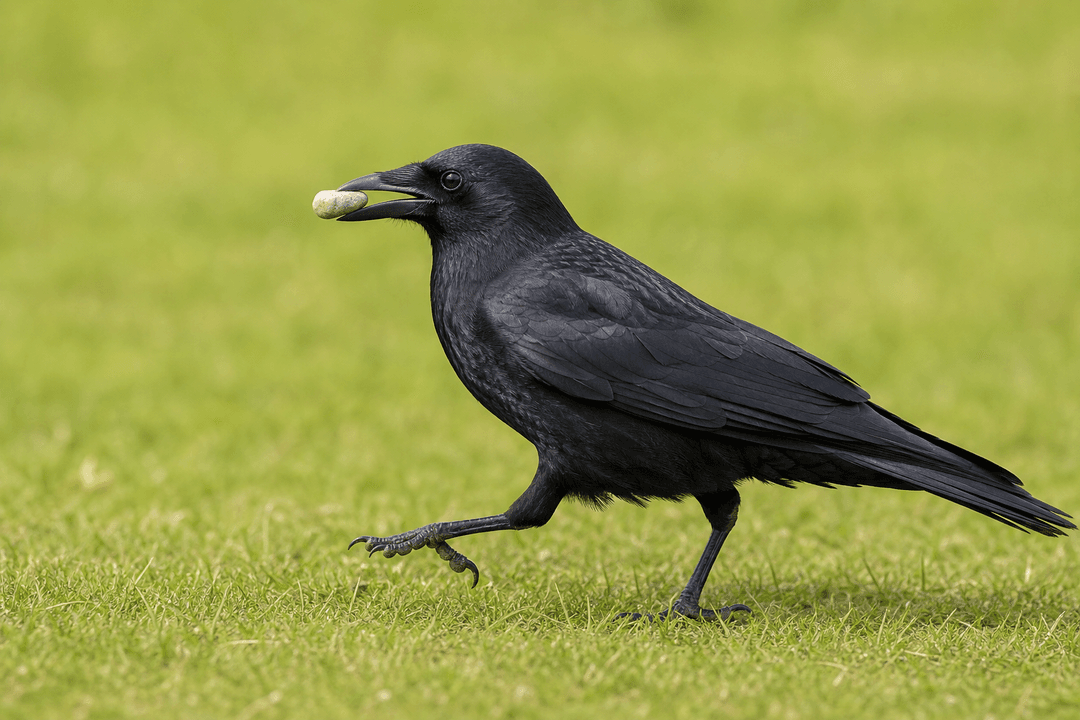
In the second experiment, the rooks were presented with stones that varied in size. Here, the rooks selected larger stones over smaller ones. The scientists speculate that the birds quickly realised that the larger stones displaced more water, and they were thus able to obtain the reward more quickly than by using small stones.
According to the team, in the final experiment, the rooks recognised that sawdust could not be manipulated in the same manner as water. Therefore, when presented with the choice between a tube half-filled with either sawdust or water, rooks dropped the pebbles into the tube containing water and not the sawdust.
Despite the fact that the study clearly demonstrates the flexible nature of tool use in rooks, they are not believed to use tools in the wild. 'Wild tool use appears to be dependent on motivation,' remarked Bird. 'Rooks do not use tools in the wild because they do not need to, not because they can't. They have access to other food that can be acquired without using tools.' As Bird noted, that fits nicely with Aesop's maxim, demonstrated by the crow: 'Necessity is the mother of invention.'
Practice 1.3
Read the passage again and complete sentences 1-6 with endings A-H.
A new study has actually
The intelligence of birds has been suggested in stories, but
Half of the birds in the experiment were immediately successful; however,
The birds promptly realised the advantage of using big stones, and so
The research showed rooks can use tools with ease, though
The rooks worked out the properties of different materials and as a result,
Study Tip There are several ways of linking ideas in a text. Notice examples such as the findings, This is remarkable, Here, the rooks, and cohesive devices such as although, furthermore, and therefore.
2. Identifying theories and opinions
Many academic texts contain the theories or views of different people or experts. Direct quotations are easily recognised by quotation marks, but a person's views or ideas can also be referred to indirectly.
In this extract, verbs such as highlighted and stating draw attention to the words of Christopher Bird.
Practice 2.3
Match statements A-F to the same idea in the passage, then put them in the order they appear.
We imagine that the rooks were soon able to appreciate the advantage of using different-sized tools.
Tool use in rooks demonstrates a common English saying.
Using tools in their natural habitat is simply not necessary for rooks.
Rooks are as intelligent as the most intelligent of animals.
In their natural setting, rooks can obtain food without using tools.
The ability of rooks is surprising, given the lack of similarities between the brains of birds and mammals.
Study Tip Look online or in newspapers and magazines for reports on academic studies. Notice how writers introduce researchers' claims, findings, and opinions.
3. Matching features
Matching features tasks are used with Reading passages that contain theories or comments about different people, places, years and things. The questions will not be in the same order as the passage.
Maths shows why words persist over time
Researchers have shown that the more frequently a word is used, the less likely it is to change over time.
The question of why some words evolve rapidly through time while others are preserved has long plagued linguists. Two independent teams of researchers have tackled this question from different angles, each arriving at a remarkably similar conclusion.
'The frequency with which specific words are used in everyday language exerts a general and law-like influence on their rates of evolution,' writes Mark Pagel, author of one of two studies published this week.
Mathematician Erez Lieberman, from Harvard University, performed a quantitative study of the rate at which English verbs such as 'help' have become more regular with time. Of the list of 177 irregular verbs they took from Old English, only 98 are still irregular today.
A separate group of academics, led by evolutionary biologist Mark Pagel, used a statistical modelling technique to study the evolution of words from 87 different Indo-European languages.
Psychologist and language expert Russell Gray, from the University of Auckland in New Zealand, was impressed by both findings. 'Despite all the vagaries and contingencies of human history, it seems that there are remarkable regularities in the processes of language change,' he commented.
Practice 3.2
Match each statement with the correct researcher, A, B or C.
We are able to recognise certain words used by people in other cultures.
There appear to be fixed rules that govern the way words alter over time.
Words that do not follow a standard pattern will remain that way if they are used often.
Certain words have kept a similar sound across many years and many countries.
We focused on historical changes in one particular language.
Study Tip For matching features tasks, scan the whole passage carefully. Some people in the list may be distractors, and you may not need to use all of the letters.
Practice 3.5
For further practice in matching sentence endings, complete sentences 1-3 with endings A-E.
For a long time, language experts have asked why
The English verb 'help' proves that
While cultures vary a great deal around the world,